Categories
Sharing

Don’t worry about Bluebeard

It’s February 2008 and I’m putting together a session on legal issues for my creative entrepreneurship students at Kings College London.

I’ve been reading Don Tapscott’s thoughts around Wikinomics and excited by the business possibilities of open source development and creative commons licensing…but the media lawyer coming in to talk to my students can’t – or won’t – cover that area.

So when the invite to the Open Rights Group workshop: Creative Business in the Digital Era drops into my inbox, I’m curious. The workshop’s in March, a few weeks after the legal session for my students has taken place, but at least I can relay any new info to them.

So I apply for a place, get accepted and trundle along to the basement in Soho where the workshop’s taking place. And that’s how I come to meet Suw Charman, former ORG Executive Director, blogging doyenne and keen social media activist.

Suw’s wearing a suit and talking legalese in a posh accent, but she’s got her nose pierced, so she must be okay.

Suw and I get to meet up a couple of times over the next few months, and it’s clear that no search for leadership 2.0 would be complete without getting her take on it.

Fast forward to August and we’re sitting in the amenable confines of One Alfred Place on a sunny Wednesday morning, talking shop.
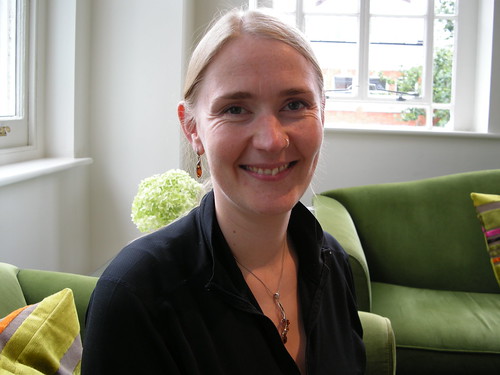
Suw loves a good open source business model

So what does Suw think the main problems are when it comes to business taking on these new approaches?

“The challenges are cultural more than anything. People don’t understand how giving something away for free can form a viable business model. There’s so much propaganda out there – in the film industry, the music industry and, to a lesser extent, the publishing industry – it’s easy for people to get swept up by it. Copyright violation isn’t theft. It’s a completely different thing. If I steal your wallet you don’t have it any more, but if I copy your music…it’s different. The main issue is mindset.”

Why is she particularly interested in what’s happening in the creative industries?

“I like the Tim O’Reilly quote about obscurity being much more of a threat to artists than piracy. The boundaries are being pushed a lot more in certain creative sectors – publishing, for example.”

Sue cites publishers such as Baen, Tor, Friday Publishing and even Penguin with its 1000 Penguins Project, as examples of businesses who are willing to experiment.

“It’s logical for writers such as Neil Gaiman to have blogs, to build up an online community. The blog builds up anticipation and then, when you actually publish your book, you can release it into your reader community.”

But Suw feels such approaches (what ORG has termed the “loss leader” model – giving some of your intellectual property away in order to sell further intellectual property) are by no means limited to creative businesses.

“For example, look at manufacturing. Look at the maintenance manuals for those classic cars that people have a soft spot for – they go for loads of money on eBay. If you’re a fan of the Ford Capri or the Ford Cortina and Ford gave you access to those old manuals online, you’d love it.”

Suw thinks that every company should do an IP audit to find out what could be released out into the market to help build and/or sustain a community.

“Obviously 100 per cent transparency isn’t good. If you’re Worcester Sauce, you don’t want to give away your recipe – that’s your unique selling point – but it’s all about being open and imaginative. Every company owns some IP that would be useful in building a community of fans. It’s all marketing. It all goes into generating warm and fuzzy feelings of goodwill.”

Suw’s not the first person I’ve spoken to to reiterate that our current Taylorist mindset has only really taken hold in the last 100 years:

“We have to remember that there’s this limited period that started with mass production and ended with digital production. [Mass social media] marks the end of a small minority of people having control. We’re seeing the democratization of culture.”

Be that as it may, Suw is clearly exasperated current legislation:

“Copyright law is becoming an ass. It’s technically illegal for you to copy a CD that you own onto your iPod. The law is so out of step, it’s becoming like Latin – a dead language. It’s not protecting the rights of the artists or the creators. It was created to benefit society. Now it’s no longer doing that. Technology has moved on, while copyright law has become massively more restrictive. You have to ask, what good is society getting out of this? When any law starts getting massively out of step with the society it represents, there is going to have to be a massive change.”

Suw is critical of the DCMS for going against the findings of the Gowers Review, which concluded that there would be no long term economic gain from copyright term extension.

“The Gowers Review was a very sensible report which recommended that we reconsider copyright law. The DCMS has completely ignored it and now says that it’s backing term extension. It all goes back to that question of propaganda. The very word piracy is overloaded with pictures of bluebeards and people getting their heads chopped off.”

So, is she optimistic for the future?

“It all depends on how successful the old school are in perverting legislation to prevent development of the natural business models. There’s so much corporate lobbying around. What’s interesting is how far the pendulum will swing one way before it comes back again.”
Categories
Sharing

Coming soon to a TV near you…

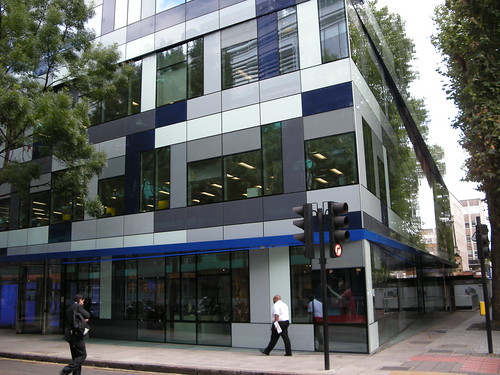
Arup HQ at 13 Fitzroy Street

The headquarters of Arup (although no-one in the firm would like to refer to them as such), is made up by three shiny buildings on Fitzroy Street, on the north-east edge of London’s West End.

Two of the buildings have been recently gutted and re-furbished, while the third, newly re-opened, was razed to the ground and completely rebuilt.

At first glance, the buildings don’t look too dissimilar to the ordinary office blocks in that part of town. But then you look a bit more closely and see a flourish here, a serpentine line there.

Arup is a hybrid firm of engineers and architects, and has been at the top of its game now for some 60 years. Sydney’s Opera House, London’s Gherkin, Edinburgh’s Scottish Parliament, Beijing’s Bird’s Nest – they all have the Arup signature.

Futurist Duncan Wilson meets me at no.13 Fitzroy Street, and shows me round the new public exhibition space, currently focusing on Arup’s work in China – nicely timed, with the Beijing Olympics are taking place as we speak.

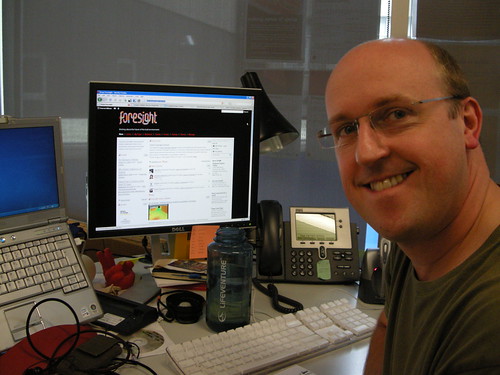
Duncan’s job, as one of the eight-strong ‘Foresight’ team, is to run ‘thought-leadership-type’ workshops and create content for the ‘Drivers of Change’ project, which publishes books and flashcards on future trends for both in-house and public use.

Duncan Wilson with the Foresight website

He admits that Arup is a great place to do this sort of work. Famous for its flattened hierarchical structure, with 10,000 employees all owning the firm, Arup is renowned for its innovative culture.

“If you go back to Ove Arup [founder] himself, his whole approach was that design should be holistic. In the 1960s and 70s, that was highly unusual. That collaborative approach (engineers working in conjunction with architects) is embedded in the culture here. There’s a ‘de facto’ sharing nature. People expect it [openness] of Arup.”

However, even Arup’s directors do not always sit easily when faced by projecs requiring open source and alternative approaches to intellectual property.

“One of the issues is that we’re starting to use new technologies. Senior executives don’t use Flickr, Facebook etc (in fact, sites such as Facebook and Youtube are banned as they are considered a waste of time and, more importantly, bandwidth). The underlying message is ‘how can we control this stuff’. But it’s mostly just a fear of the unknown.”

One of Arup’s current projects is the design of Don Tang, a huge eco-city in China.

“We’ve whole teams of engineers working on the modelling process, seeing what works and what doesn’t, trying different things. We already use games technology for a lot of the modelling. But it would be great if, rather than just number crunching in isolation, we could open source some of this information, put it into a Sim City type of environment and watch what happens.

Traditionally, like most industries, the engineering sector doesn’t share, but Duncan can see huge public benefits opening up it certain types of data could be pooled.

“Take post-occupancy valuation for instance. That’s when a team of architects go back into a building to see if it’s functioning correctly, if it’s providing the type of environment it was designed to provide. The role of the facilities manager within companies is becoming more strategic and important as environmental concerns are increasing. I can see a future where the data of what a building is doing – eg, how much energy it’s using, and where – can be streamed for public consumption.”

You read it here first – time for the ‘what my building is doing’ channel.

Categories
Openness

The opaque face of leadership


It’s 1989 and I’m on my way to the VT library at Sky Television to pick up a rushes tape. Unit 5, Centaurs Business Park (Eurosport offices) is linked to Unit 6 (where the library is) by a long, carpeted corridor. There is glass running along one side, providing a view of the Sky staff car-park; the opposite wall is lined with portraits of benevolent, smiling Sky News presenters.

I recognise the man coming down the corridor towards me from photographs. He is short, wrinkled and bald. He is expensively dressed. I know he owns the firm I work for and is my ultimate boss. In contrast, he knows nothing of me and, until now, has been undisturbed by my very existence.

Wishing to make an impression, and overwhelmed by the ‘elevator pitch’ nature of the situation, I blurt out what I think might be a suitable opener, something along the lines of “Mr.Murdoch, isn’t it time we did some more high budget, quality programming?”

Silence as Rupert Murdoch walks quickly past me, wincing slightly, as if bothered by a fly.

I’m reminded of this now, sitting at an outdoor table in sunny Exmouth Market, chatting to Nic Price, ex BBC Learning & Development (now working with the equally talented Gerred Blythe at Lighthouse Experience).

We’re talking about managers we’ve known and loved, and how web 2.0 type stuff is enabling corporate communication on a whole different level.

Like many of his former colleagues, Nic is full of praise for the BBC’s Director of Global News, Richard Sambrook. Sambrook was encouraged to start up a blog some years ago by the BBC’s then Head of Knowledge Management, Euan Semple.

The blog is well-written, insightful and pertinent, read by a growing international audience, as well as BBC insiders.

But what’s been particularly interesting, according to Nic, is how the blog has acted as a kind of virtual ice-breaker between Sambrook and his colleagues:

“Suddenly, people [at the BBC] were reading his blog and then feeling it was okay to talk to him when they saw him walking down the corridor. They felt they knew something about him, about the way he saw the world. They felt they could start a conversation.”

Of course, not all company executives can write. As Nic says, there’s nothing worse than the ‘CEO diary’ which has been written by a PR person.

But they don’t have to blog, do they? Maybe they’d be more suited to a Youtube channel, or a Flickr page?

Or, as Nic says:

“They could just sit in the canteen on a Friday afternoon and buy people coffee. That’s participative. That’s web 2.0”

Sadly, none of this can help with the memory of my encounter with a stoney-faced Rupert Murdoch. Maybe if I’d been more familiar with his hobbies and interests, our meeting would have been different. Anyway, I guess Murdoch already has his blog. It’s called “The Times”.

Categories
Context

Re-use, repair…recycle?

Why are we obsessed with business longevity?

Okay, so mobile phone giant Ericsson started out as a timber merchant and advertising multinational WPP as a maker of shopping baskets – but they’re the exceptions in a climate where only the minority can succeed in reinventing themselves.

Organisational psychologist David Jennings says even the most innovative companies are beginning to question the reuse, repair mantra – maybe it’s time to simply recycle?

David Jennings

“I’ve a friend working at Shell and he says there’s a growing belief there that maybe it’s okay for a company to have a shelf-life? When the oil runs out, then maybe it’s time to close up shop. And Shell can become a sort of rich compost for the companies of the future.”

“Look at the burst of activity around Cambridge Business Park [in the UK]. A lot of the start-ups and small businesses were able to draw on a highly skilled pool of labour when a large employer – I can’t remember for sure, but it might have been Thorn — had made people redundant.

“The same thing could be said of San Francisco’s Bay Area. In its early days in the 1950s, Hewlett-Packard was able to put the silicon into Silicon Valley in part because they could feed off the ‘compost’ of lay-offs from the military, aerospace and radio industries that had previously occupied the area.”

Indeed, why aspire to be a Madonna when you have the temperament of a Britney? The important thing is to know what, exactly, you’re good at, and why. And then recognise when it’s time to let go.

Categories
Passion

The developer’s dilemma

David Jennings has been interested in non-hierarchical ways of organising since he did his MSc in occupational psychology at Sheffield in 1986.

“There are all sorts of challenges to co-operative working. The same examples [of successful co-operatives] always come up: Scott Bader, Suma, etc.”

David cites Charles Landry’s book, What A Way To Run A Railroad, (Comedia, 1985) as a great analysis of the reasons co-operative working often failed. The gist of this book was that a lot of people were creating their own organisational ‘cramps’ and restrictions that were counter-productive.

“In the UK, there’s always been opposition to co-operative ways of working. But if you look at other countries, such as Sweden, you’ll see a deeply democratic culture that looks more favourably on this sort of thing. Volvo, for example, did a lot of experimenting with semi-autonomous work groups.

“The main problem with genuinely co-operative organisations is that they’re simply not scaleable. Perhaps if [the co-ops of the 1970s] had had wikis and microblogs, and a more cellular structure, they would have been more viable. Now, technology is actually catching up with ideas that have been around for a generation.”

In the wake of the co-operative movement of the 1970s, and no doubt as a reaction to the popularity of charismatic but ego-driven leaders of the 1980s, thinkers such as Peter Senge and Arie de Geus started to develop ideas around distributed leadership – leadership as a process, not trait; something to which everyone in an organisation could contribute.

Meanwhile, (so David tells me), collaborative software was developing. There was something called computer supported co-operative work (CSCW), developed by software engineers in conjunction with psychologists and ethnologists.

CSCW – also known as groupware – was a sort of early social media. By the early 1990s, programmes such as Lotus Notes were marking the beginning of people meaningfully working together online.

David mentions a paper published in 1989 called “Why groupware applications fail” by Microsoft researcher Jonathan Grudin, where Grudin looked at the personal versus the social benefits of CSCW.

As David recalls, one example addresses the disastrous uptake of early online calendars:

“Bosses would have access to invidual employees’ calendars, and get their secretaries to schedule in meetings. The only way people could get out of those meetings was by saying they had something else on that they’d not put in the calendar. Employees realised that by keeping their calendars up-to-date, they’d actually loose more than they’d gain, so it wasn’t worth it.”

The technology we have today may or may not have altruistic values, but it is far more user-centric: to re-invent a phrase, we could call this the developers dilemma: do you meet the selfish needs of your individual user, or aim to serve the greater good? The trick is to compromise neither.

As David puts it, “if you can make the social benefit a by-product of the selfish interest, then it’s much more sustainable. That’s the beauty of something like book-marking on del.icio.us”

And, remembering the failings of the 1970s co-operative movement, maybe a bit of selfishness is a necessary thing.

Categories
Listening

Reaching out to the Long Tail

There’s nothing like the web for mass participation. The web delivers numbers that long-suffering TV executives can only dream of.

As Mint Digital’s Andy Bell says, “that long tail curve keeps recurring. But it’s not a cookie cutter – it’s a tool in your armory. You can’t expect things to work to the same formula every time. You have to keep re-working it.”

Andy gives the following examples:

  • Islandoo [Mint’s first commission – a casting site for RDF/C4 show, Shipwrecked]: 40-50,000 people joined and socialised via this network because they were interested in being on the island. Two years on, Islandoo has still been Mint’s biggest project in terms of pages views (35m in its first six months).
  • Buried Alive [project developed for the BBC which won a 360o prize at MipTV 2007]: looked at ways of re-using data that had been buried in the BBC archives.
  • Joseph Choir Search [BBC]: at its peak, 2m page hits a day, and 1,000 choirs taking part. That idea couldn’t work on linear TV because you simply wouldn’t have the space to showcase 1,000 choirs.
  • Unsigned Act [competition sponsored by Orange to find the UK’s best unsigned rock groups]: Mint is creating a platform for 3,000 bands.

For Andy, these projects are just the tip of the iceberg: “the web is uncrowded territory. There are so many new ideas to be uncovered.”

The challenge is reaching out along that long tail of users to create something that is meaningful to each of them:

“With Islandoo, we created a unique social micro-climate with thousands of users. But the downside to that model was that it only made 12 people (the ones who got selected to be on C4’s Shipwrecked) really happy. I’m more interested in replicating the feel of Innocent’s Village Fete or Nike’s Run London – in those situations, everyone’s a winner.”

You and read more about Andy’s thoughts on How to be Generous here. And see a video of his recent presentation at 2gether08.

Categories
Passion

Keeping it real

When Andy Bell and Noam Sohachevsky started Mint Digital three years ago from their kitchen tables, little did they know how quickly the company was going to grow.

Mint creates mass participation websites for cross-platform entertainment projects such as ABC Family’s Greek, Channel 4/ All3Media’s Skins and Sony Ericsson/ Orange’s unsignedAct. Now, thanks to two rounds of angel investment and a lot of hard work, Mint has offices in London and New York, and 24 full time employees.

Sitting back in his chair in the garden of Mint’s local cafe, Andy takes a sip of water (if you want a clean-living company director, Andy’s your man) and reflects on how his relationships with co-workers have changed.

“I used to think ten people would be an ideal size for the company, now I’m finding myself thinking 50 is about right. People trust you more as a bigger company, and you can take on larger scale projects.

“I’ve felt, recently, that the tone of the company is changing a bit. It’s still a great atmosphere. But there’ve been a couple of examples recently that have made me think.

“I’ve always been keen on eating lunch with everyone. With ten people it’s easy to go to the shops and grab a picnic. Once you get to 24 people, the atmosphere changes slightly. Suddenly, it’s not ‘us’ buying lunch, it’s ‘the company’ doing it for you.

“Also, we’ve always tried to do out of hours stuff, like the Mint Sports Day we had a few weeks ago. But once you’ve got 24 people turning up on a Saturday for a corporate sports day, it seems like work. I guess if we’d done it on a Friday, it might have been different.

In an effort to keep any ‘them’ and ‘us’ barriers as low as possible, every new employee is given share options and the Vauxhall-based offices (in an old Marmite factory – visiting Disney executives like it because they say it’s ‘street’) are open plan.


“More people inevitably means more of a hierarchy,” admits Andy. “I’m ten years older than some of the new developers and designers coming into the company, so it’s inevitable that I’ve got more experience. I’ve tried and tested different ways of doing things, and I should pass that on to them. But we try to delegate responsibility as far as possible.”

When Noam, Mint Digital’s Chief Design Officer, was away last year, there were some concerns about how new-ish designer Tom Harman would step up to the plate. But Tom did a sterling job, and now enjoys a higher level of autonomy than he did previously.

Both Andy and Cameron Price – Mint’s CTO – are inspired by the sort of stuff Joel Spolsky [CEO of respected US software company, Fog Creek] writes in his blog. Spolsky spent a stint in the Israeli army so is possibly more qualified than most to say why command and control can never work in software development.

Above all, Andy wants to make sure that everyone is happy and – hopefully – enjoying themselves. The ‘Mints’ aim to “go on an outing” at least every month, and, once a year, staff from both the London and New York offices get together at Scoles Manor in Dorset for a few days of intensive brainstorming, development and social activity.

“Business is the most social thing,” says Andy. “If over the course of a few years, you’re working alongside others, putting your life and soul into something, it’s very rewarding.”

Categories
Listening

The Barnet Crusader

One day, back in 2005, council worker Dominic Campbell found an unsolicited email in his inbox. The email was inviting him to a business breakfast on ‘customer insight’. The breakfast was at Mosimann’s and it was free, so Dominic thought ‘why not?’

At the time, Dominic was working in a back office for the IT department of the local council in Barnet, one of London’s leafier outer boroughs. He had been there for five years (since graduating in Geography from Manchester University), and was relatively happy with his lot.

Then, at the breakfast, he met James Governor from the UK consultancy, Redmonk.

“He was just completely bananas and brilliant. He said there was this thing called del.icio.us and this thing called salesforce. And we were just nowhere [in terms of using these new tools].

“I tried to get James in to the council to open them up and get them to understand this stuff. I completely failed…but James did enough to inspire me to leave and set up on my own.”

Dominic is sitting with me (ironically enough), in the walled garden of the Euphorium Bakery in Islington. He’s clearly relieved that he took the chance to set up Futuregov because, three years on, things have come full circle.

Dominic is now back at Barnet Council, but working as a consultant, and implementing the kind of IT solutions he only dreamt of as an employee.

A bit of background: Barnet Council is led by Councillor Mike Freer, who blogs at www.leaderlistens.com. Outside Barnet, not many people in the UK have heard of Mike, but he may be about to become a bit more of a household name. He’s due to stand in Margaret Thatcher’s old constituency, East Finchley, in the next election and is tipped for the Cabinet if David Cameron wins.

Ever since Webcameron, the Tories have been upping the ante to Labour over which party does new media best. So it’s in Freer’s interests to look web 2.0 savvy. In fact, he’s done such a good job, that even Labour are keen to get involved in his work (the DCCG recently invested a significant amount in ‘social marketing’ for Barnet council).

All in all, a good time for Dominic to be around, then?

“Barnet is at the vanguard of redefining what a council is. They’re trying to work out how they can become an enabler [for the people] in their area. They’re trying to do something better than sending out Surveymonkey surveys. They’re trying to open up the policy-making process.”

I tried to get James in to the council to open them up and get them to understand this stuff. I completely failed…but James did enough to inspire me to leave and set up on my own.”

Barnet runs a project called ‘The Future Shape of Barnet’ in which it attempts to redefine the role of the local authority, and how it should work.

As part of this project, the council is engaging with residents and crowdsourcing ideas from staff and residents alike using web 2.0 technologies (with the help of Futuregov). Barnet now uses wikis on its intranet, and has got a page on Facebook.

“OK, so there’s only 25 fans at the moment, and they’re all council employees, but the very fact Barnet is on Facebook moves it to a different place.”

All well and good, but the fact that Barnet is so unusual says a lot about the state of play in the IT systems of local government.

“Anything freewear or open source is seen as flakey or dangerous. There’s a saying that you won’t get fired for buying Microsoft. All these people are Microsoft certified and Microsoft is flooding local government. Almost every time I go into a council I walk past a SharePoint salesman.”

Isolation is another problem:

“For people working in councils, the only contact they get with the outside world is when someone visits from SAP, Logica or Microsoft. This person tells them that whatever they’re selling is cutting edge, and they’ll hand over £1 million.”

So what are the chances of all this changing?

“Putting organisations like that into a network instead of running them as walled hierarchies is a massive step. At the moment it’s only beginning to happen, and that’s just in marketing.

“It’s gotta be another twenty years [until things really start to change]. The people in their twenties now who’ve grown up with computers, they’re the ones who are going to do all this [web 2.0] stuff naturally.”

But for Dominic, the future for genuine social change should really be outside the hands of local government altogether:

“To be honest, I’d rather government step back and let the social innovators [private entrepreneurs] do stuff. Local government should actually worry about little else than being a series of listening posts, keeping an ear to the ground on what people really need and want.”

Categories
Openness

In Blog we trust


Arseniy Rastorguev (known to his UK friends as Archie) works in the Moscow office of MMD, a leading corporate communications firm for central and eastern Europe. Clients include IBM, Visa and HSBC.

MMD’s regional director in Moscow, Stephen Locke, is ‘a big fan of social media’. Archie started as a consultant with MMD’s technology team two years ago. He’s now working across corporate communications, charged with masterminding MMD’s embryonic social media arm.

I met Archie at Tuttle last week, but now we’re sitting in The Hospital, having a chat about the social media scenes in our respective cities.

Archie says local firms in Moscow tend to be very ‘top down’ and that he’s found a big difference between dealing with the straightforward pyramid hierarchies at home and the more matrix-ed multinationals: “In Russia, the CEO is very much ‘in charge’; with international companies it’s a very complex chain of command”.

Whatever their structure, all businesses show a similar caution when it comes to participative media:

“Companies perceive social media as too risky and too freakish. They see it as a nerd sitting there with a computer.”

In contrast with what most people might think in the UK, Archie cites Starbucks as one of the first companies to ‘get it’.

“Starbucks attempts to be a good company. It was one of the first companies (with www.mystarbucksidea.com) to understand that there isn’t a difference between PR and how your company really operates. Everyone loves Starbucks in Russia because the local coffee shops have bad service, terrible coffee and terrible food. We hope that Starbucks will kick out the local coffee shop owners.”

When most companies decide they want to do something with social media, says Archie, it always has to be on their terms:

“I like what Olga Rasulova of Edelman says (at least, I think it was her idea), that building your own social network is the equivalent of building a beautiful boutique in the middle of the desert. Many kilometres away, on the edge of the desert, there’ll be whole cities with streets and shops and ports and people. Your boutique may look amazing, but what’s the point? You need to go to where the people are.”

Archie knows all about where to find Russian consumers online. He’s been a paid-up member of the Russian blogosphere since he first got an invite code to Livejournal six years ago.

“My first degree was in political science. When I graduated, I got a job as an assistant to the director of the Higher School of Economics. At the same time, I was doing some writing for an educational journal. They were putting together a board of experts and invited me to join. This board based all their discussions on Livejournal.

“Livejournal is the core of the blogosphere in Russia. For four reasons, firstly, you can have a friends feature and can read all their blogs [similar to RSS]; second, you can have a closed community – post private posts to friends only; third, comments are threaded – this leads to an instensive and structured discussion, fourth, Livejournal is based around user communities. In Russia it’s the communities that are important rather than the individual bloggers themselves.

“The blogging community in Russia has grown up not around geeks but around the intelligentsia – academics and political commentators. Blogging gives people a way to express themselves outside the boundaries of traditional media. Since the press is not very opposition friendly, the blogosphere is the main outlet for opposing viewpoints.”

Blogging is so popular in Russia that Yandex – the leading Russian search engine – lists the top-ranking blogs on its home page every day – having your blog featured here, says Archie, is the equivalent to having your by-line on the front page of a national newspaper.

So, how about business? Why does he think blogging has great potential for business in Russia?

“Before Glasnost there was obviously a lot of propaganda but now the business press in Russia is pretty impartial. Journalists have mastered the art of the non-biased report. People are bored with the bland, balanced, two sides to every story approach.

“In the blogosphere, you don’t have to pretend to be impartial. People express their opinions – and then get corrected if they’re wrong. The press journalist won’t write a piece about a company putting out a crappy press release or a company’s PR representative constantly phoning him or her, but the blogger would. The blogger is much closer to the consumer.

“This is not really about ‘new’ media. It’s the normal human conversations we’ve always had but they’re now accessible.”

“With old style PR, as long as you were nice to the press, you’d be fine. Today, everyone is a media outlet. Companies are having to become more and more genuinely transparent. PR and corporate social responsibility are stretching from being a business function to being an integral part. And, more than anything else, the blogosphere is a stock-market for trust.”

Categories
Miscellaneous

The view from Bangalore

Mala Bhat is over here from India on the government’s ‘highly skilled immigrants’ programme. (Well, with the lack of respect for good ideas in the UK, and fondness for lager, is it any surprise we need people like Mala?).

“In Bangalore, like most of India, the big companies tend to have everyone working in cubicles,” says Mala. “They’re the sort of places where you have to make an appointment to speak to the CEO.

“It’s much better where the CEO works in an open space alongside all the other employees. That way he sees how all the projects are actually being carried out.

Mala recommends the US company Thoughtworks as having “a totally unique approach”:

“They give employees the freedom to work from home (traffic is terrible in Bangalore) and, in the office, each team sits around the same table. Employees are encouraged to come up with innovative ideas and if you have a software project you want to develop and work on, you can do it.”

The head of HR (sorry, Chief People Officer) at Thoughtworks is called Matt. Mala is going to get me his contact details.