Monthly Archive for February, 2009

For he’s a jolly good Fellow?

Centralised or distributed?

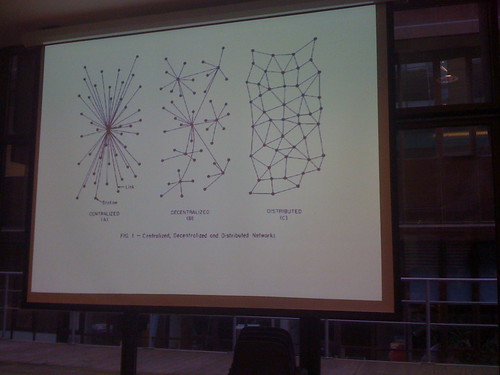
“We’re at A, we’d like to be at C.”

Laura Bunt, Networks Co-ordinator at the RSA, is standing in front of a large projection of a diagram illustrating three different networks: the first, marked ‘A’, shows a number of lines radiating from a single point; the second, ‘B’, shows a handful of smaller clusters, simplified versions of ‘A’; the third, ‘C’ is a block of diamond shapes – a fishnet of connected nodes.

The RSA or rather, to give it its proper title, The Royal Society for the Encouragement of Arts, Manufactures and Commerce, is one of the UK’s oldest and most respected membership organizations.

The Society was founded in a Covent Garden coffee shop in 1754 by William Shipley, an artist and teacher. Shipley’s co-founders included the leading progressive thinkers of the time: Benjamin Franklin, Samuel Johnson and William Hogarth,. The aim of the Society they set up was to award premiums to innovative liberal arts and science projects, and “to stimulate enterprise for the common good”.

Today, the RSA has a global “Fellowship” of around 27,000 members and a civic remit “to develop and promote new ways of thinking about human fulfilment and social progress”.

This afternoon, we’re in a meeting room at The University of Westminster for an open workshop intended to explore the practicalities of creating a truly networked RSA. Twenty-five people, Fellows and non-Fellows, are sitting around four tables. In the middle of each table a pile of cling-wrapped plasticine and bags of Lego hint at the fun to come.

Since November 2007, the RSA Networks project (backed by NESTA) has been looking at new ways to engage and empower Fellows. The first year was intended to be one of “chaos” – a period of experimentation and innovation - followed by a year in which ideas would “coalesce”, allowing a clear roadmap for a third phase, “leadership”, to emerge.

We’re half way into the second year and possibly still at the “chaos” stage.

The ambition of the RSA Fellowship team, says Laura, is very much to build a strong distributed network. She likes to think that the Society’s internal office team of ten is there to support and be fully integrated with RSA Networks. She admits that the realization that a distributed network was needed and how that network might interact with or even “become” the RSA was not a firm idea at the onset but one that has developed organically over the past 18 months.

Another Laura, Laura Billings, who’s the RSA’s Senior Fellowship Researcher, starts to talk about practical developments. Two clear ideas have come out of the Networks project so far:

  • To create a Fellows Charter which will define expectations and responsibilities of Fellows (written and ratified by the Fellows)
  • To develop a taxonomy, a tagging system, written by Fellows (sounds a great idea but I’m not at all clear how this second will work in practice).

It all sounds good – but there’s a lot of anger in the room. The Fellows are restless.

First up, Paul Springer, who argues that the lack of accessibility at the RSA’s London headquarters (the rooms of this vast building that Fellows are allowed into amount to “the library and a tiny airless room in the basement”) is indicative of the attitude to fellows; although he adds that: “The fact you want to go from A to C is wonderful. That wasn’t even being said a year ago”

Laura and Laura listen with the worn patience of parents who are watching their children throw food over the kitchen as they try to feed themselves. It’s an ugly, messy thing, this feedback process. But once you’ve started on this particular road, it’s difficult to turn back.

But Paul’s comments are just the tip of an iceberg. There are others in the room who are also angry but can’t seem to be bothered to comment. Is it possible they might be giving up on the whole project?

RSA council member Malcolm Forbes stands up to give a brief presentation about the social media tools that have been introduced since the Networks project kicked off. There’s a wiki on Wikispaces, a news stream on Twitter, plus Google and Facebook groups. The Facebook group grew quite quickly to 600 members, but then plateaued. The wiki has been relatively inactive since early 2008.

The RSA is dealing with the same problems faced by many businesses today: What does ‘networked’ actually mean to us? Just how networked do we need to be, and why? How do we become more ‘networked’? How do we manage a networked organization? Do we need designated ‘leaders’ or just ‘co-ordinators’?

When I speak to people during the breaks, frustration is a key word. And also a growing sense that the workshops, seminars and ‘tasks’ (from setting up a Facebook group to building a model with plasticine that represents “the RSA you want to see”) are now simply a diversion from the real goal of getting this 250 year old organization to actually open up.

I get an image of RSA CEO Matthew Taylor with a pack of more or less amiable but hungry dogs. He keeps throwing out balls for us dogs to chase, but what we really want is a bone.

The Fellows I speak to seem to agree that the problem rests largely on Matthew’s shoulders. One points out that Matthew’s background as a Chief Advisor on Strategy to Tony Blair means that he is used to operating in a political, rigidly hierarchical world, seeing things very much in ‘top down’ terms.

There’s no denying that Matthew is intelligent, charming and has impeccable left-leaning credentials, but its completely possible that he feels uncomfortable with any full abdication of responsibility, and the idea of truly letting the “natives” run riot.

From where I’m standing, it seems that The RSA has flourished under Matthew Taylor: The Society has a stimulating programme of thought-provoking events, and a reasonably high profile in the media. But ninety per cent of this is Matthew-led. It’s Matthew who capably chairs virtually all the discussions, and gives interviews on behalf of the RSA across press, TV, radio and web.

When you go to the RSA website and read the blog, all the entries are by Matthew (in fact, it’s called “Matthew’s blog“). If you click on “Who we are”, you get a three minute video of Matthew. Meanwhile, over on the “Fellowship” page, you are given the opportunity to “Meet a Fellow” : this is a four minute video of one (1) Fellow – not very representative of the 27,000 who make up the RSA.

Of course, this is by no means all Matthew’s fault. I’m sure it was his marketing team who encouraged him to write the blog. And the blog’s wonderfully un-ironic tagline “Politics, brains, social action and the day to day life of the RSA’s chief executive” must have been written by someone in PR.

A few days after the workshop, there are signs that a message of some sort may be getting through: a new thread on membership has started up on Matthew Taylor’s blog, one to which comments are invited – and, for the first time, the RSA’s Chief Executive is responding.

Maybe there is hope for change after all?

A cultural revolution

Had a great time at the London Twestival last Thursday but - like most others - strangely didn’t spend the night blogging, tweeting or texting about it (though I did manage to take some pics).

Luckily The Guardian’s Jemima Kiss recorded some voxpops so even if you weren’t there, you can get a flavour of the evening.

My fave quote has to be from Alex Hoye, CEO of digital agency, Latitude, talking about getting used to using Twitter:

“One of the first struggles I had was that my work persona, my home persona and my family persona all had to be one and the same and initially that meant some filtering - and there is some filtering in there - but on the other hand it means that you’re actually more natural in all three now which is a real cultural revolution in some ways.”

Social convergence in action - love it!

The slow boat to China

It’s 1873 and the Reverend Henry Parkes is in Canton, China, writing a letter to his boss, the General Secretary of a Methodist missionary society, in London.

“By next spring I shall have been resident ten years […] My objective in writing by this mail is to request permission to return home […] For myself, and more especially for my wife and family, I feel it’s necessary, soon, to have a change. In this view my medical advisor concurs.”

Henry is a Wesleyan Methodist minister and one of a small group of priests who have been asked to take Christianity to China following China’s defeat by the British in the second Opium War of 1856-60.

Henry and his new wife, Annie, and their children live on the eastern side of Canton Province (now known as Guangzhou), an area where smallpox, cholera typhoid and bubonic plague are endemic. Hundreds of thousands will die in the region over the next few years. With four children under the age of six, Henry is understandably concerned for the health and safety of his family.

Henry has now been in Canton Province for ten years, having arrived in China in August 1862, after a five month voyage from Southampton. As a missionary, his job is not only to preach, but also to help establish schools, hospitals and orphanages. Apart from the Parkes and a few other missionary families, there are no other Europeans in the region.

In the aftermath of the Opium Wars, there is little love lost between the Chinese and the British. Henry and his family live under threat of attack. Mandarin Chinese is not an easy language to learn and the lack of communication with the people around them, in addition to getting used to the local food, manners and customs, means that life is extremely difficult.

Henry studied to become a Methodist missionary at Richmond College, London, but although well-versed in theology, he received no practical training in the life skills needed for coping with this new environment. As a result, the Parkes family are incredibly isolated.

Henry would have expected a response to his letter to take around six months to arrive by ship. From the wording of a second letter, written seven months later, it’s evident that no response has been received. In the meantime, two of Henry’s children have tragically died. Over the next ten years, Henry writes a number of letters to the General Secretary; in each, he requests permission to come home. In 1882, nearly twenty years after arriving in Canton Province, the Parkes are finally allowed to return to England.

I watched celebrity chef Rick Stein tell this story on BBC1 on Monday as episode three of the latest series of “Who Do you Think You Are?”. Henry Parkes was Rick’s maternal great grandfather, and Rick traveled to Hong Kong to find out more about his life. The scene in which Rick reads the letters written by Henry is incredibly moving.

It’s an sad story - and all the more shocking in the context of today’s hyper-connected world. For us, the idea of being stranded on one side of the planet while your boss, manager or CEO chooses to ignore you on the other is unthinkable. Today, it would only take a handful of well-written blog posts, a campaign organized by your friends on Twitter or Facebook and/or a few hundred signatures via an e-petition before your employer was forced to address your needs - and relocate you.

It’s true, employers don’t always behave as they should (the same goes for employees, of course). But at least now we have the means to ensure all voices, however troublesome or inconvenient, are heard.

The funny thing is, in some instances, particularly in established organizations where there is a legacy of doing things a certain way, it seems some managers still behave as if that slow boat to China was the main method of communication. A friend of a friend who works for the UK civil service sums it up:

“Two hundred years ago, people wrote letters and it would take four weeks to get a reply, so you could basically go ahead and do what you wanted without waiting for permission to be given - or denied. People still run their own fiefdoms like this! Even if you’re a child of this generation and you get posted to Tonga for 25 years, you might have to ask, what are you going to learn [about the UK technology sector] in Tonga?”

To borrow a phrase from George Orwell, it seems all people are networked, but some are more networked than others. There’s no prize for guessing which type of person has the edge.

One last point: it’s interesting to read on Wonkette that one of US presidential candidate John McCain’s campaign advisors, Mike Murphy, is now, literally, on a slow boat to China. As one of McCain’s more savvy advisors, he’ll no doubt appreciate the irony more than anyone.

“We don’t need help. We are not invalids.”

I’ve been doing a bit more digging around and come up with some more ‘interesting’ facts about the social media presence at this year’s Davos:

  • For the second year running, there was a YouTube Corner. Heads of state, CEOs of multinational corporations and various world dignitaries and could stop by to give their response to questions posted on the video sharing network. Kofi Annan, Ed Milliband, Paolo Coelho, The President of Rwanda and The Chairman of Intel Craig Barrett all shared their views.
  • Prior to Davos, both YouTube and MySpace ran competitions for one lucky subscriber to get all expenses paid press accreditation at Davos. Pablo Camacho (YouTube) and Rebecca McQuigg (MySpace) became “Citizen Reporters” - interviewing everyone from Bill Gates to the president of Columbia between them.
  • Facebook ran live online polls during 12 of the key sessions. During one session, Advice to the US President on Competitiveness, Facebook users were asked if Barack Obama’s proposed stimulus package was on target. According to Techcrunch, 120,000 responses were recorded in twenty minutes: 59 per cent said “no” and 15 per cent said “yes”. These results were played out directly over the heads of the panelists (including Rupert Murdoch, CEO News Corp, and Ellen Kullman, CEO DuPont) who only minutes beforehand had generally backed the package. Nonetheless, World Economic Forum officials were apparently “delighted” with the polls.
  • While 2007 appeared to be the year the bloggers first arrived ‘en masse’ at Davos, 2009 saw plenty more faces from the social media/tech scene: journalists Michael Arrington (Techcrunch), Robert Scoble (Fast Company TV), Jeff Jarvis (Buzz Machine) are becoming veterans, alongside Web 2.0 entrepreneurs such as Tim O’Reilly (O’Reilly Media), Jimmy Wales (Wikipedia), Mark Zuckerberg (Facebook), Chad Hurley (YouTube) and Tariq Krim (Netvibes).
  • For anyone in any doubt that Davos is social media savvy, the World Economic Forum now has a Twitter feed, a fan page and group on Facebook, and a dedicated photostream on Flickr.

My final point isn’t about social media specifically, but about the importance of accommodating diverse viewpoints – especially important if you prefer not to be humiliated in public: illustrated in the story of the exchange between poor old Dell CEO, Michael Dell, and the pithy Russian President, Vladimir Putin.

As if any further proof was needed of fading Western dominance – Putin’s put-down of Dell’s founder summed up the new world order. Peter Gumbel of Fortune magazine reports how Michael Dell was first up to ask a question after Putin’s 40 minute speech:

“[Dell] praised Russia’s technical and scientific prowess, and then asked: “How can we help” you to expand IT in Russia. Big mistake. Russia has been allergic to offers of aid from the West ever since hundreds of overpaid consultants arrived in Moscow after the collapse of Communism, in 1991, and proceeded to hand out an array of advice that proved, at times, useless or dangerous. Putin’s withering reply to Dell: “We don’t need help. We are not invalids. We don’t have limited mental capacity. The slapdown took many of the people in the audience by surprise.”

Putin’s remarks are good to bear in mind as we think about our (definitely subjective, probably patronising) attitudes to other cultures in shaping the “economic forums” – and corporate boardrooms - of the future.

As Davos is no doubt learning, it’s great to use social media to gather diverse viewpoints, but it’s our reaction to these views, and our accommodation of them, that we need to really think about.

Time for a diverse Davos

Davos is over for another year and the obligatory pictures of middle-class, middle-aged white men in suits are all over the media.

This year, the meeting was more pertinent than ever with the small issue of global financial meltdown weighing heavy on the shoulders of the 2,500 attendees.

Last Sunday, The Observer’s business Editor, Ruth Sutherland, expressed her dismay in seeing only five women on the abridged list of business leaders attending the conference. In a comment piece for the paper, she didn’t mince her words:

“The male Davos elite remains mired in its own preening self-regard and complacency. They have wrecked the world economy, but seem oblivious to the idea that they may not be the best people to rebuild it.”

Ruth Sutherland makes some suggestions to help re-dress the rebalance – including Oxfam director Barbara Stocking’s idea for Davos to broaden its definition of leadership, by introducing female community leaders from Africa, for example.

Someone I know used to work for the World Bank, and someone else I know for the World Economic Forum. I need to check whether or not they’d like to be named because they both speak less than favourably about the experience, in essence saying these organisations are among the most badly run they’ve ever come across. Not good in a world that needs thoughtful, enlightened leadership now, more than ever.

I’m not saying that women are the only answer, but more diversity across our leading financial and decision-making institutions is essential.

OK, so now I’ve got that off my chest, it seems that some good things did come out of this year’s Davos. Firstly, there seemed to be a great deal of social media types attending, which can only be a good thing.

As Robert Scoble said on Twitter: “The execs at Davos were very curious about Twitter and Qik/Kyte/live video. It will be interesting to see how many pick up these new things”.

So, what actually happened at this year’s Davos?

Well, Umair Haque’s ideas appear to have been well-received (by Tim O’Reilly, at least).

The “illuminating” Jeff Jarvis (thanks Steve Moore for that lovely adjective), hosted a workshop where a model for open banking was hotly discussed and debated (via Sam Granleese).

And Joanne Jacobs and the Amplified team ran a successful experiment in using social media to drive citizen participation to the sessions.

Robert Scoble complains that there wasn’t enough focus on small businesses, but then, maybe that’s no surprise in an arena where big business dominates the invite list.

Again, more diversity, more voices – that’s what we need to really move forward, and that’s exactly where social media can help.

NB: I picked up the above “news items” from www.hashtags.org. If you’re aware of any other Davos developments significant to social networking/Web 2.0, please let me know!

Tears are us

Luis Suarez writes eloquently about the joy of seeing leading sportsmen who are not scared to show their emotions.

His post reminded me of the final episode of the BBC’s Million Dollar Traders which we watched on the iplayer on Monday night. This three part series took eight “ordinary people” and gave them basic training followed by two months to run their own (£1m) hedge fund. The two months happened to be September and October 2008 - possibly the worst two months in the history of hedge fund management.

In one scene, the two self-made millionaires who are running the operation (one of whom is actually donating his own funds to the “experiment”) discuss the lacklustre performance of a highly intelligent but nervous rookie – they decide it’s time to ‘let her go’.

The discussion between these two powerful men - ‘she’s going to cry, I know she is’ - is fascinating, as is the interplay between the dismissed girl and her fellow rookies – half of whom walk out with her. The two “bosses” stand in their glass-fronted office and watch awkwardly as the walk-out takes place, agreeing that it’s best not to “interfere”.

Of the three novice traders that remain, one, an ex-soldier, seems genuinely perplexed that there should be any gesture of support, asking, repeatedly, “what’s going on?”.

Another (interestingly, a single mum), then goes on to be praised by the fund managers for her “impressive” (ie: lack of) reaction to the entire episode. She is told that this cool-headedness is essential for City success. There is much talk of how emotions, and emotional ties to others, can only get in the way of making money.

Interestingly, there is a whole separate incident where another novice - an environmentalist - despairs at his inability to make money through ethical trading. He is singled out for criticism - the suggestion is that ethics will only interfere with profits.

This portrait of City trading as the towers of mammon begin to topple is excellent and should be set viewing for business studies students everywhere. I wonder if the two men who led the show have reconsidered their stance? I suspect there’ve been quite a few tears shed on and off the trading floor in the past few months.

As Luis remarks on his blog, now is surely time for businesses to reconnect with their emotions:

“Now, can you imagine the corporate world of the 21st century, the one we all feel social software is slowly, but steadily, humanising and shaking itself inside out, behaving in such powerful way? Can you imagine your business re-gaining that human side of things? Those feelings? Those emotions?”

Here, here to that!

This same week, we’ve seen a report from the Children’s Society saying that the “selfishness” of UK parents is a major factor in the unhappiness of the UK’s children. Once again, working mums are singled out as particularly self-centred.

Why, oh why do we keep going back to this same old, broken record? Blaming working mums is the easy solution. Talking about how to construct more family-focused, humanised workplaces is far more difficult. And how to re-construct and support not the family but the extended family.

To be fair, The Guardian and The Scotsman, among other media, were up in arms about this, too.

Because this type of work is the future. It’s good to see that someone of Julia Hobsbawm’s intellect thinks so, too – she’s got a new book out which champions flexible working as the most significant trend of the 21st century.

I know my 2 year old daughter wants to spend time with the parents she loves, but in seeing myself and my partner go out to work, she’s learning that it’s normal to work, and that work can make you happy and fulfilled. She’s sat in on business meetings from the age of 12 weeks and listens in to conversations about work, between her parents, our colleagues etc. This has improved her vocabulary and I’m sure in later life will make her more instantly at ease in business situations.

And the flipside is that the workplace also benefits from having the input of parents (especially mums) who spend lots of time with their children. These people have vast lives outside the boardroom and inevitably see things differently.

OK, so maybe women are, on balance, more likely to show emotion (eg: cry) in certain situations, but why do such outbursts need to be a problem? Can’t we just learn to deal with them?

Diverse voices, thoughts and interpretations are key to the worldly governance that today’s companies need if they want to survive in this fragmented, global marketplace.

CEOs faceless on Facebook

“All these work-related conversations are taking place on Facebook, and the CEOs are missing out!”

Sofia Quintero almost spits out her coffee with impatience. She’s been studying for an MA in media and communications at London Metropolitan University and has just handed in her dissertation – on Facebook at work.

For the paper, she interviewed five CEOs from different sectors – and uncovered this disconnect:

“They allow their employees to use Facebook, but they see it as ‘oh, something that the kids do’. They won’t ‘friend’ or be ‘friended’ by the people they work with. They keep their profiles separate. But what’s the point of that?”

We’re sitting in the new Tinderbox cafe, in Angel, North London, on a chilly Friday afternoon at the tail end of January. All around us, people have got their laptops, Blackberries and i-phones out, hooked up to the wifi, working, social networking and generally communicating.

“Social convergence is a reality - why don’t they see it?”

I’ve never thought about the term “social convergence” in the simplistic context of public/private before, but I like it. The faster we work, the more we need simplicity.

Blogger Rob Vanasco put his finger on the problem in a recent post:

“People want more and more to bring their data together to one central, easy to use place. However, people also want to be able to separate their data for their friends, family, co-workers, potential employers, and online acquaintances.”

And Rob goes on to give a good example:

“Someone heavy into the tech industry who uses Twitter, or a service like it, might not want their Twitter post automatically updating their Facebook feed. Their family and friends might not want to be inundated with post after post about what article they are reading, up to the date tech news, or what sites they’ve just bookmarked or added to their RSS feed. This could potentially turn their friends/family off to reading their updates, and could be a good way to lose friends on social networks. “

He adds that “contacts on Linkedin don’t need to see “party pictures” or your latest mobile uploads of your child’s first haircut.”

But as home-working, flexi-working and other work/life hybrids become the norm, surely the hard and fast division of work/social personas is increasingly irrelevant?

We’ve already seen this happen: post the dotcom crash of 2000/1, there was an explosion in laptop use in coffee bars – back then it seemed to signify you were either a student who’d been thrown out of the library or someone who’d just been made redundant (from your hi-tech start-up) and was filling out applications online. Now laptop, coffee/green tea and jeans looks positively modern and industrious. The fact you’re not wearing a suit is neither here nor there. But it’s taken a while for that to change.

I’m convinced that the same will happen with the traditional “line you cross at your peril” that defines the employee/boss relationship.

Like Sofia, I think we’re going to see an increasing number of bosses lowering their defences on Facebook – even if it involves taking up multiple profiles.