Archive for the 'Metanoia' Category

In the knowledge garden…

A friend of a friend of mine spent years in business development for the BBC before he decided to pack it all in and become The Master Genie of The Universe. Needless to say, The Master Genie no longer has much time for mortal work, being kept busy granting wishes to anyone who chooses to ask, via his Myspace page.

A few weeks ago (when he popped in for dinner), The Master Genie alerted me to a number of websites that he felt were pointing the way to the future of leadership. I’ll list them here for the sake of completeness, if nothing else:

It’s strange, this hippy thing, because hippies can be a bit like Jehovah’s Witnesses in their constant talk about the looming Apocalypse, and the fact that their (to the majority, slightly barmy) ways are the only route to salvation.

A lot of this can, frankly, be put down to bad marketing – Whirl-y-gig founder, Fraser Clark, banging on about over-use of black bin liners in an illegible font isn’t going to impress anyone, yet a book like The Celestine Prophecy, covering similar issues (though not, specifically, black bin liners), sells over 20 million copies worldwide and spends 165 weeks on the New York Times bestseller list.

Now that the liberal, free-spirited baby boomers are becoming grandparents, isn’t it inevitable that ‘hippy’ values become more mainstream? It seems that we’re all buying organic vegetables, wearing tie-dye and inhaling at High School (thank you, Barack).

The irony is that the recent inflation in petrol and food prices is forcing even the most cynical of us to reconsider our consumerist behaviour. Last month, the UK saw a decline in car use for the first time in years (thank you Steve Moore for pointing me to this), while in the US, sales of gas-guzzling cars have nose-dived (thanks Janet Parkinson!) and airlines saw an unprecedented drop in air travel during their usually busy Labor day weekend.

Sales of energy-saving lightbulbs are soaring. Concerns about health and carbon footprints means that people are turning to freshly-made food, local producers and farmers markets, forcing fast food giants like Macdonalds to rethink their menus and approach.

George Por, executive coach to businesses, government and NGOs, happily admits to being a bit of a hippy. There’s no doubt he has the credentials: a student of sociology, he was jailed (for 20 months) in the 1960s after leading university protests in his native Budapest; exiled from Hungary, he studied tantra in India at Puna in the ‘70s and moved to Berkeley, then Santa Cruz in the ‘80s. His website is decorated with flowers and mind maps.

“It’s clear that we’re at a transitional time in human history,” says George. “Everywhere you can see signs that old systems are dying out while the new ones are still to come.”

The thing about George is that he seems to be getting the right sort of people to listen to him. He was a senior research fellow at INSEAD and a visiting researcher at the London School of Economics, before becoming PrimaVera Research Fellow at Amsterdam Business School. He currently advises both the European Commission and the European Investment Bank.

George is keen to support what he refers to as “the transformation of organisations” and what he calls “evolutionary leadership – large scale systems thinking”.

“I like to think of myself as a community technology steward,” he says. “It’s an emerging profession – at the join between business, technology and personal development.”

(It’s interesting just how many people I’ve spoken to for the book seem to like to apply their own labels to what they do, rather than accept a conventional job title.)

George is interested in what he calls “knowledge gardening”. It’s in pursuit of this, he says, that he spends much of his days, “evaluating gadgets and platforms in terms of their potential contribution to collective intelligence; looking at the organisational requirements; finding out what technology can do for us.”

I’m quite happy to believe in the positive evolution of humankind, but would like some hard scientific facts. George points me in the direction of the following:

Okay, so I’m going to try and have a conversation with Otto – watch this space!

Lloyd Davis on the birth of Tuttle

“In the future, organisations aren’t going to be the same. This is about different ways of organising. In fact, it’s not the ‘organisation’ we’re talking about any more, it’s the ‘collaboration’.”

So says Lloyd Davis, consultant, ukulele player and all-round good egg. Since January, Lloyd has been running what is now known as the Tuttle Club – a space where social media types in London can get together to chat, work and collaborate.

“This time last year, a few people were starting up coffee mornings, where everyone would meet in a café somewhere and chat. The mornings were popular, but it was all very ad hoc.

“I felt there was a need for something more permanent, outside of an organisation, where people working in social media could meet and talk on a regular basis, and hopefully go on to actually create projects and maybe work together.

“Ever since I saw the film Brazil, Harry Tuttle [the lowly engineer who is able to single-handedly challenge the system] has been a hero of mine. When I started up this ‘social media café’ it seemed to make sense to call it the ‘Tuttle Club’.

Lloyd clearly delights in the random nature of the group he has created.

“You get such a diverse mix of people and back-grounds – geeky start up types, social media consultants, advertising/digital agency people, classic media people (by that I mean BBC, Channel 4 etc), creative people – musicians, filmmakers, mobile geeks…

“It shifts – we get different dominant cliques from one week to the next. One week there a whole load of musicians turned up, the next there was a load of film scripts being passed around.”

“Anything could happen. People come with different perspectives and come up with creative solutions. I want to encourage that.

The model has proved so popular that ‘Tuttle Clubs’ are now spreading to other parts of the UK – Brighton and Birmingham are both starting up in the next few weeks.

With growth come calls for a more organised approach, but Lloyd is adamant that this type of gathering/collective can only thrive if the framework is loose.

In organising Tuttle, there are two golden rules:

1. Let go of control
2. Minimise structure

“I have to work very hard to stop it becoming more structured” he admits. “There is some structure, there is a ritual: every Friday, 10am, Coach and Horses. Step across the bar. That’s it.”

“The Tuttle Club is not about competing with Starbucks, One Alfred Place or The Hospital. It’s about the people you’ll meet there. It’s about talking, innovation, chatting, sharing. And the people who say I can’t come because I’m at work are missing the point – because this is work, just in a different way.”

Scaling the ivory towers

In 2001, Adriana Lukas was working for a large financial firm in the City of London when she started blogging with Samizdata, a quasi-political blog “for people with a critically rational individualist perspective”.

Back then, there were dozens of bloggers rather than millions, and the term social media wasn’t even a glint in Mark Zuckerberg’s eye.

Adriana liked blogging so much, she left her finance job and started up an agency, the Big Blog Company, telling businesses how to use blogs.

With a degree from Oxford University and an earlier stint spent at ‘Big 5’ consultancy, KPMG, she could have been your archetypal management consultant.

“No, no, I hate that term,” says Adriana. “A friend of mine says I’m an ‘insultant’ – I much prefer that.”

Companies be warned, it’s not the blogs we’re really talking about here. The blogs are simply an entrée, a conversation starter, or, potentially, a metaphor. Adriana’s big blog crusade is all about business change.

We’re chatting over chilled water (it’s hot, it’s August) at Adriana’s town-house in Chelsea. And Adriana’s feeling frustrated and maybe a little bit fed up.

Adriana at home in Chelsea

“I’m amazed when I go into businesses how little they know about the outside world. Managers are so bogged down in the day to day minutiae of running the organisation they don’t have a chance to be aware of what’s really going on.

“Businesses are SO behind. If you think about a typical business organisation, certain words come to mind – control, autocracy, systems, closed – whereas if you look at the web, the networked world, it’s completely the opposite. The networked world is completely heterarchical.

“We’re talking about two totally contradictory environments – offline versus networked. It’s a war!”

As Adriana sees it, the business structures we see today are the result of many different layers, wrought first by industrialisation, then by the impact of mass media and, finally, by complex legal regulations.

This tangled mesh of restrictions is virtually impossible to un-pick. As a result, any positive steps towards change are difficult.

“Take pharmaceutical companies, for example, they’re not allowed to talk about their products [drugs] unless it’s in a certain way – and that makes whatever’s written, unreadable. They’re totally straight-jacketed. ”

The established systems within businesses are equally restrictive:

“You are more important than your job description but, in business, it’s the job description that matters.”

Traditional business behaviours throw up “limiting mental models” which people need to change if they are to evolve. The first step is becoming aware of these models.

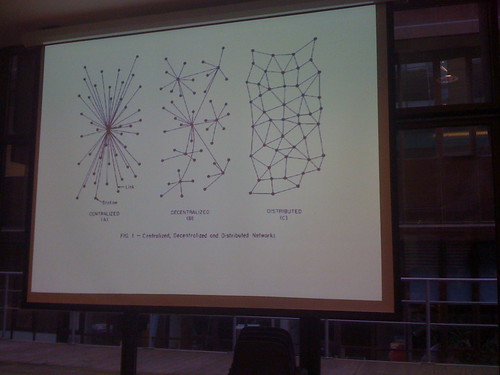
“For example, when people talk about networks, we still tend to think of a bicycle wheel, with ourselves at the centre, rather than a loosely connected pattern of nodes.”

“We need to start looking at the ‘because’ business model – ie, I don’t make money with this product, I make money because of this product. Because people are using that, they can be persuaded to pay for this.

“That’s what businesses have to understand – the money’s there. But until you change the mental models, you’ll never be able to benefit.”

It’s still early days, and Adriana admits it’s often hard to see exactly what we’re meant to be working towards: “It’s as if the amoeba are just beginning to separate [over here] and we’re looking at fashion design [over here].”

Is that the stage we’re at, then - amoeba separating?

“Yes – exactly! It’s like the five blind men trying to describe an elephant. One says ‘it’s tusks’, one says, ‘it’s a tail’, the other says ‘it’s a trunk’…but none of them can feel the whole elephant. That’s where we are.”

Adriana is furious that certain companies - like Noka chocolate, which “practices a very 1.0 ways of doing things” - can be denounced on the internet and still carry on as before.

“A food blogger in Dallas did an expose of Noka and revealed that there was a 150 per cent mark up on their products. Noka were completely exposed, completely humiliated, but they’re still going strong. I’d really like to know - how much difference do these things [blogs, wikis etc] make? How much damage do they really cause?”

Indeed. How long does Adriana think it’s going to take before the ‘2.0’ message gets through?

“Maybe there’s going to be a dark age. The movement for net neutrality is getting quite big in the States – and it will do here. It’s possible the telcos could decide to restrict access to the pipes. But you could kill the web but you can’t kill the net. The geeks will find a way.”

And for now?

“I’m focusing on building up pressure on the side. I’m focusing on people rather than companies. I think the individual is far more dynamic, advanced and creative [than the business organisation].”